Saturday, February 26, 2011

Fritter and WAIST the hours...

Kolda's WAIST team - 'Space Corps'
Avatars, storm troopers, Jedi, Lady Gaga....you name it
I just got back from a simultaneously fun, crazy, exhausting, and productive several weeks in Dakar. First on the agenda was to take the GRE. Predictably, I did well on the English and essay sections, and terribly on the math ones.  I had the company of a few other peace corps volunteers, both for study sessions and at the actual test, which was nice.

Next came the agroforestry summit, in Thies.  We got to see a fish farm and a chicken farm, learn about fruit tree pests and trench some young mango plants to be grafted next season for the master farmers. We also exchanged seeds, which is always to be looked forward to.  I got a huge rice sack full of sisal starts for the Kolda region, which I'd been hoping for since last year.  Sisal is such an easy and great live fencing shrub; everyone's been asking for it, because there's no seed source near here that I'm aware of.

From Thies we all got PC vehicle ride to Dakar for a day of inter-regional and other non-governmental organizations networking with volunteers.  It didn't really turn out to be very useful for me, personally.  We got to meet several new Kolda volunteers, though, who have been relocated from Niger after the program was shut down there.  Minnie and Dan - agfo and health, respectively, I believe - are awesome, and we all think our region's volunteer group just keeps getting better and better (and bigger and bigger).
Palpatine and Vader are just like the rest of us, really

Leia up to bat


Han, Leia, Obi-wan, Yoda, and...
somehow Vader snuck into the Good Guys photo
Finally, after this networking day came the event that we daydream about all year - the West African invitational softball tournament (forgive me if I explained all about WAIST last year already). Volunteers from Senegal, the Gambia, Mali, Cape Verde, and Niger, as well as American expat and Senegalese leagues came together for three days of softball. Some teams are competetive; some are complete slapstick spectacles of rowdy indifference to the rules. Each team comes up with a theme and dresses up for games, so as you can imagine, attempts at outrageous costumery are often more spirited than shows of athletic ability.  When we're not playing, we're enjoying American food and beer, and generally having a great time in the pool and on the dance floor (there's a party at a different venue every night).

Kolda won two games - two more than our region has ever won in the history of being a region!

I've spent the past few days recuperating in the Kolda house, and getting some agfo seed collection and other work done. It's nice to be back in a city where I can bike everywhere, or pay a $1 cab fare, unlike Dakar's outrageous traffic and prices. The only downside is the 100F-106F weather....it was still nice and cool in Dakar.  But good to be home!


Shelling moringa oleifera seed at the Kolda house
 

Wednesday, February 2, 2011

....2011 has begun!

Usman the Guinean, left us after
he got paid for his peanuts.  He
says he'll move back permanently with
his wife in a few months! We hope so!

It's been a lazy few weeks in Sare Fode, just watering the garden and studying for the GRE.  It's this time of year that makes me appreciate Senegal and this job - not terribly hot, but hot enough you can grow anything you want to; and since it's not the main agroforestry season, and it's always culturally acceptable here to lay around all day, I get to do a few hours' work in the morning and evening, and then lounge about and read all day.  When else will I ever have such an awesome job!?  At least that's one way to look at it.


Regional strategy 'retreat'

There have been a few events to break up the monotony of watering and GRE prep - our region had a 'regional strategy' planning meeting recently, where we shared what we're all working on, and what our goals are, as work sectors and as a region. I stayed after that to write a grant proposal for a palm reforestation project in a 10 kilometer stretch of seasonal floodplain in our rural community.  This will hopefully be an inter-regional cooperative project, taking place during the rainy season, and resulting in several thousand improved variety of oil palms being replanted.

See the couple lonely palms?  This will all be replanted,
inchallah.
Working in Tumani's garden
A week or so later, Massaly (my supervisor, and the pilot farmer project administrator) came down to Tumani's demonstration site in Sare Gagna for a workday, in which we dug improved beds and outplanted all of Tumani's nursery starts in companion planting formations.  There were around 10-15 people there, volunteers and local villagers, and we all worked pretty much straight from 9:30-5:30 or so.  It was an incredibly productive and fun day.


Nene and I watched from the village

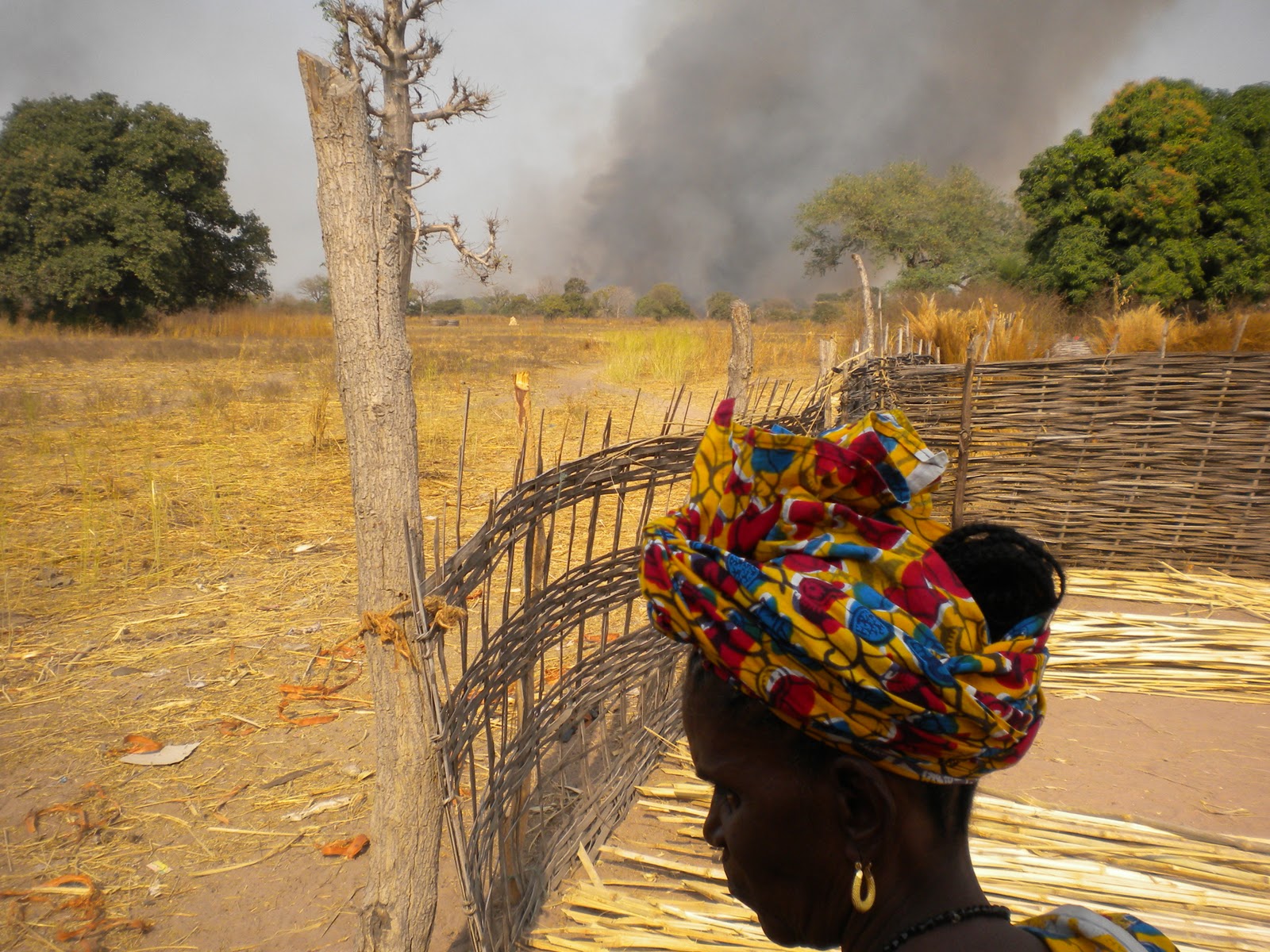
It's the dry season, and people are also burning their fields - a combination which often leads to bush fires, like the one we had a couple of weeks ago.  It got so close to our village that everyone, men and women alike were rushing out with buckets of water.  It turned and went off towards Kolda, but was a little nerve wracking for a few minutes.


I'd like to make a request of anyone who is thinking about sending me anything, or doing anything to help me out here - instead, I'd love any donation, however small, to Jessie Seiler's Peace Corps Partnership grant for library books for Senegalese schools.  Sare Bidji will receive a portion of those books.  Thank you! :)
The link is: https://www.peacecorps.gov/index.cfm?shell=donate.contribute.projDetail&projdesc=685-164

Tuesday, January 18, 2011

ADVENTURE!

Sitting atop a gravel pile in Dakar.


Christmas brunch at Dakar regional house
2010 ended nicely, with Ian coming to visit for two weeks, after a week of frustrating delays stateside. He finally made it in to Dakar early on Christmas morning, and we spent the day with a bunch of volunteers in Dakar.

Dangling heart talisman for good luck
The next day we headed off on Ian's first grueling sept-places journey, and made it down to Kolda by the evening.
Ian beats peanuts off the plants
We spent a day with the Kolda folks at the house, and then headed out to the village, where my family promptly gave Ian a new name, Usman Diamanka, and put him to work in the peanut fields.

Ian and our little stalker
He quickly learned to say 'jam tan' ten times fast, appreciate a cold bucket bath, and constantly make or be the brunt of Pulaar-style jokes.

The women get Ian all dolled up.
I probably exhausted Ian unnecessarily, but we went around and greeted every single household.  Ian made friends in particular with Aliu  our household, and another little fellow who followed us around Sare Bidji.

Then we allowed the village to throw us a wedding.  More accurately, we threw ourselves a Pulaar style wedding at the demand of the village. It was pretty strange, but kind of fun, and made for some awesome photos!  The village was so delighted, too, as you can imagine.

Ian dancing in wedding garb the first night


Ian's holding the all-important bindle.
So many old women dancing!
 I was less than delighted that I didn't get the usual assorted remnants of fabric as gifts, however.  I guess they thought a toubab doesn't need gifts...


Finally the next day, after the bride had to do chores all morning, we got to put on normal clothes and enjoy the party.

.


We did some more visiting the next few days, out in Sare Gagna and in Sare Bidji, then headed back towards Dakar.  We stopped in Diaobe, a small town with a huge weekly market.  Then we took an incredible long overnight bus up to Kaolack, and from there went out to Jinack Island, an island that is 1/2 Gambia and 1/2 Senegal. We only had one night to spend there, but it was beautiful.
Jinack Island  

Boat trip out to Jinack

Sunday, November 28, 2010

Feasting Follies


Sadio, Me, and Wopa ready to go visiting on Tabaski

It's been a rough couple weeks of holidays here. 

Djiby, Jawo, and Usman slay the goat

First, the household got all excited for the slaughter of a goat for Tabaski, and the ensuing feasting.  I got out the bag of candycorn I'd saved to give the kids who come around visiting in their new clothes (they were wary at first, because the pumpkins and corn kernels look like the two kinds of hot peppers that grow here...)
Trick-or-treaters, basically

The first day found me in an already slightly ill state, from some unknown cause, but after the first meal of fried meat and rice dripping in oil I was in true gastric distress. (It lasted several days, just long enough to hold me over till the next illness - a nasty cold that every single villager has contracted).

Helping cut onions
I wasn't the only one who reacted adversely to the surfeit of rich food - after that first meal, Woura and I requested soup and plain rice for the next few days. By the second day of meaty, oily meals everybody in the household had stomach cramps and was begging for milk and biscuits.  It made me wonder, yet again, why they spend all that money and time preparing rich meals that just upset their digestive systems....


Then came Thanksgiving.

Herman, as we christened him
Now it was our turn to get excited for the slaughter of a turkey, who had been bought from a nearby town and was being kept live in the backyard of the regional house. None of us were too savvy, but Geoff took the helm and we managed to kill, gut, pluck and deep-fry the fellow.  The rest of us spent all day and a fair amount of footwork and money (not to mention earlier contributions from the States that had arrived via mail) to get the necessary items for all the classic Thanksgiving dishes.
I made the dressing
Meg and Geoff 'carve' (e.g hack)

The dinner turned out to be a masterpiece, better than last year.  We even went around and said what we were thankful for.  We stayed up playing Scrabble, Taboo, poker and other games, and talking wistfully about holiday traditions back in the States...


Charlene, Wilma and Cara working on a puzzle
The next morning it all came back to haunt us, and it was a rare moment when the two bathrooms were unoccupied or not foul-smelling.  I'd be willing to bet that 3/4 of that delicious food we labored over came out less than fully digested. Actually, I still haven't completely recovered, and that made me realize that we, like Senegalese villagers, also eat certain foods for the sake of holiday tradition, regardless of the discomfort we know it will cause us afterward, and the effort and money it costs to prepare. I guess I can't judge anymore.

I hope everyone had a great holiday back home and the beginning of winter weather isn't cramping your style too much. Sending love from Kolda!

I brewed an IPA the day before Thanksgiving

Tuesday, November 9, 2010

Little Hut in the Bush

At Kai's prodding, I finally gave my blog a real name. I've seen some really clever ones, so please don't judge. I just hope it's at least obvious that I'm referring to one of my favorite childhood series, the Little House books by Laura Ingalls Wilder.

If you know anything about me, you know that I have a bit of an obsession with pioneers. I'm not talking about space age pioneers, or pioneers of modern medicine - since I was little I wanted to be an American pioneer of the Oregon Trail-traversing order. Mid-nineteenth century, no running water, no electricity, little log cabin, living off the land and carrying out all the hand skills like spinning, sewing, and churning butter that are lost to most modern Americans - that was the dream for a long time. Eventually I acknowledged that, yes, I was glad I hadn't died of pneumonia as a baby, and yes, computers were pretty useful, and yes, in a world of over 6 billion people, it isn't really plausible for everyone to have acreage and cook over a wood fire. But my love of the 'olden days' never really went away (as I'm sure most of you are aware), and suffice it to say that when I was asked at my Peace Corps interview how I would handle the possibility of being placed in a site with no running water or electricity, living in a thatched hut, I essentially told the woman that if I wasn't placed in a site like that, we could forget about the whole thing.

Well, I got my wish, sort of. I've spent a year living in a mud and grass hut, with no running water or electricity, plowing and harvesting by hand, riding on donkey-pulled carts, cooking over an open fire, and washing laundry with a bar of soap and a bucket of water. It has made it difficult, at times, to do my job, that on some level I don't want to change these people's way of life; it's what I always wanted. At other times, it's been frustrating to see how far behind even nineteenth century American farmers they lag - nobody can mend or sew their own clothes, the literacy rate is very low, nobody even has a washboard for the laundry, the tools are of such poor quality, and craftsmanship of any kind is hard to come by... People just seem so much less skilled and driven than I expected.

It's one of the most common complaints among volunteers, that the average Senegalese farmer does not seem to show any initiative in improving his own life. One of the biggest realizations I've come to is just how much a part of our culture the 'American dream' attitude is. Sometimes it seems like, in the way development work is attempted, this attitude is taken for granted - for example, if you hold a free grafting training, you would expect everyone who came to go home and graft trees, or if the villagers get a milling machine from an NGO and it breaks, you would expect them to find a way to fix it, rather than letting the investment go to waste... There are certainly some Senegalese who show initiative and a desire to improve their lives, but many seem to act like the benefits of development work are a given, and refuse to really make any changes in their lives to meet the developers halfway.

Senegalese people will readily acknowledge this to you, too. I can't tell you how many villagers say to me, shaking their heads, 'white people work much harder than black people'. The most common English saying they repeat to me is 'Time is money'. Clearly they are getting the developers' 'hard work = getting ahead' message. But maybe the message is a little anachronistic. They know full well how far they lag behind the developed world and how much they are missing out on - they know they're not pioneers of anything, that no matter how hard they pull up on their bootstraps they'll always be catching up, while they see around them the evidence of the 21st century already in the grasp of Europeans and Americans and their own immigrant relatives.

Well, I'm not trying to be depressing, and I'll keep attempting to make opportunities for individuals to improve their lives in small ways. But on a larger scale, if we are ever going to lessen the divide between rich and poor nations in the interest of global harmony, I don't think relying on the work ethics of those in the most humble circumstances is the way to do it.

Thursday, November 4, 2010

Back in the Merry Old Land of Senegal


Been back in Senegal for a couple of weeks now, and had a lot of fun giving gifts from America. Here's a picture of the little outfits I brought back for Sadio and Aliu. Aliu's got his toy motorcycle there, too. The best gift by far was the Red Cross solar and hand-cranked radio, which works beautifully. It's interesting to see how people here view things that we might call 'green' or 'sustainable' in an appeal to trends or political standpoints, like this radio. They just see it as something that is obviously desirable and superior - 'why would anyone ever use batteries again if they have the money to buy technology like that?' they wonder. It's a good question - we've been using solar powered basic calculators almost exclusively for years, and yet we don't see solar powered cell phones/chargers or radios or even solar panels for homes as anything more than an item for situations where conventional power isn't available (e.g. Red Cross radio), or a sort of statement from people who are 'into' the sustainable movement. Why isn't there unanimous excitement in America for development and improvement of the kinds of technology that make us less dependent on conventional power sources?


Wopa also had her baby a little while after I had left - a little girl who is my namesake, Diatou! Here's a picture of the romper I brought back for her. There are also some family photos behind her - that day they brought out stacks upon stacks of pictures they had saved from previous volunteers and local photographers and we looked at them for hours. It just seemed like such a universal family thing to do.

By the time I got back, the millet had been harvested, and now every few days the women spend the entire afternoon threshing it. Now all the field work is revolving around the peanut harvest. The men are digging up the peanut plants, letting them dry, and piling them into huge mounds (you can see Usman, our adopted Guinean transient worker, carrying the smaller piles on a big stick). The women and I then spend our mornings in the field picking up the stray peanuts that have been detached from the plants in the course of uprooting. That's a ton of peanuts, and provides for our household's daily peanut sauces. Within the next couple of weeks, some of the rice should be ripe and we'll start harvesting (here's Nene proudly showing off our faro). It'll just be Nene and I, since the young women don't really know how to harvest, according to them, and they also have the millet threshing to keep them busy.


For the past week I've been in Thies with Tumani Diamanka, the pilot farmer in Sare Gagna, for another training. It was a little disruptive to leave site again so soon, but it's been a good training, and I've gotten to see a bunch of volunteer friends that I missed.

The pilot farmers learned about grafting, composting, companion vegetable planting, pest treatment, and accounting and budgeting. Here are a few pictures from the classroom and the practical grafting workshop.

Demba Sidibe, probably the most knowledgeable tree guy in all of Senegal, is our agfo program director. Here he's talking to the pilot farmers about grafting and taking care of mango seedlings.

I think Thies is my favorite city in Senegal, although it would be nice if people here spoke Pulaar so I could communicate. There are many good restaurants here, several educational institutions, pretty neighborhoods... One of our favorite restaurants here is a chicken place that we refer to as 'Chicken Diby'. For approximately $5 you get half a roasted chicken, a salad, and french fries. You can see the guy cooking over the fire behind the restaurant.